


A useful surfing in Japan map is less about collecting famous pins and more about choosing a coast where you can check conditions, park, eat, rest and change plans without spending half the day driving. Around Hyuga, Okuragahama Beach and Kanegahama Beach make a practical east-Kyushu base for beginner-to-intermediate surf travel.
What should a surfing in Japan map actually help you decide?
A surfing in Japan map should help you choose a workable daily radius, not promise a particular wave. Two coastal pins that appear close can be separated by mountain roads, headlands, or an awkward return route. For a short trip, map your accommodation, beach parking, food, fuel, and one non-surf option before saving a long list of breaks.
Start with regions, then beach roads
Japan’s main surf-trip regions include Pacific-facing Chiba and Shonan near Tokyo, Izu, Shizuoka, the Kii Peninsula, Shikoku, and Miyazaki on Kyushu. Each has different airport, rail, driving, and weather patterns. Use a nationwide map for the first decision, then focus on local access.
Hyuga sits on the Pacific coast of northern Miyazaki Prefecture. It suits travelers wanting a quieter, car-based coastal base rather than a city beach. JR Hyuga-Shi Station is the main rail landmark, but the beaches are not walkable from it: allow roughly 15–20 minutes by car to Okuragahama Beach and 20–25 minutes to Kanegahama Beach.
At dawn, the useful part is simple: park near Okuragahama, check the lines and wind, then decide whether to surf or drive the coast instead.
Put access notes beside every surf pin
For each saved beach, note the parking location, toilet or changing plan, drive time from your stay, and where to stand for a first look. A map pin may place you above a cliff, on the wrong side of a river mouth, or at a narrow road without practical parking.
At Hyuga, Okuragahama and Kanegahama are straightforward starting points, but wind, swell, tide, crowds, and entry locations still change. Watch the water before carrying boards down.
Map the return to your accommodation
A surf day also includes wet gear, food, tired passengers, and the trip back. For groups, draw a short triangle between your accommodation, first beach check, and evening meal plan. Keeping that area compact makes the trip flexible rather than timetable-driven.
Is Hyuga a useful stop on a Japan surf trip?
Yes. Hyuga is useful for travelers who want Pacific-coast surf access, a car-based itinerary, and more than one nearby beach option. It is less suitable if you need city nightlife or plan to rely only on trains and walking.
Okuragahama Beach: a clearer starting point

Okuragahama Beach is a long beach break with beach-side parking, roughly 5–10 minutes by car from Hyuga Surf Camp. It is known as a beginner-friendly place to learn the rhythm of a beach break, although conditions vary daily. Its open sandy setting and simple parking-to-check routine make it a clearer first stop than Kanegahama for many newer surfers.
Still, assess current, shorebreak, surfer spacing, and entry points. If you are learning, arrange lessons or rentals directly with a local provider in advance and confirm what is included. A beach pin does not include equipment or instruction.
Kanegahama Beach: assess it more carefully
Kanegahama Beach is south of Okuragahama, around 10–15 minutes by car from Hyuga Surf Camp. It has reef-break and beach-break features, so entry, bottom conditions, tide, and experience level matter more. It can be an option for experienced surfers when conditions have energy, but it is not a beach to choose simply because it looks impressive.
For mixed-level groups, check Kanegahama together, then let less experienced surfers choose a more suitable session elsewhere if needed. Agree on the parking-area meeting point before anyone enters the water.
Seasons are clues, not forecasts
Miyazaki’s Pacific coast can be surfed throughout the year, but temperature, wind, swell sources, and suit choice vary. Autumn typhoon systems and winter patterns can affect the coast; summer can bring heat, holiday crowds, and changing conditions. Treat these as planning clues rather than conditions can be favorable when swell and wind align.
Check locally near departure, bring layers for early mornings, and pack a windproof top. A damp wetsuit on a windy beach can feel cooler than expected.
Do not treat a saved pin as proof that a break is safe for your level; assess water, tide and entry on the day.
Reef and rock hazards at Kanegahama need more care than a simple beach-break description suggests.
Keep clear of take-off zones and secure boards where wind or shorebreak can move them.
If conditions exceed your experience, use the day for a coastal drive instead.
How do you turn a Hyuga surf map into a real day plan?
The most practical Hyuga surf day begins with a beach check, leaves the middle flexible, and gives the group one meeting point. Do not commit to a full-day schedule before seeing the water.
First morning from JR Hyuga-Shi Station

If arriving by train, collect your rental car before heading to the beach. Check the company’s rules for roof racks or interior board transport, buy water and breakfast supplies in town, then drive roughly 15–20 minutes to Okuragahama.
Use beach-side parking rather than a roadside shoulder. Spend ten minutes watching where surfers enter and whether they are spread out or gathering around a peak. This is both basic safety and local courtesy.
Morning check
Drive from JR Hyuga-Shi Station to Okuragahama Beach in roughly 15–20 minutes, park by the beach, and watch the water before changing.
Choose the session
Stay at Okuragahama for a simpler beach-break approach, or assess Kanegahama only if the group’s ability and entry make sense.
Keep an afternoon route
Eat and rest, then use the 20–30 minute coastal drive toward the Hososhima sights if you are not returning to the water.
Keep a non-surf route ready
The Hososhima area works when conditions are unsuitable, surf plans are short, or part of the group wants a dry day. Cross no Umi is roughly 20–25 minutes by car from Hyuga Surf Camp. It is a Pacific viewpoint over a sea-cut rock formation, not a surf break.
Umagase Cliffs are roughly 25–30 minutes by car from the guesthouse and deserve a slower stop. Wear shoes with grip, stay on established paths, and keep children close near cliff areas. Omi Shrine can be paired with the same drive, leaving time to return before dark.
Pack for the unglamorous parts
Bring drinking water, towels, dry clothes, a rubbish bag, offline navigation, and a charging cable. Keep wet surf gear separate from dry layers. One person should be responsible for keys and departure time, especially when the group splits up.
- Save offline pins for accommodation, Okuragahama parking, Kanegahama parking, Cross no Umi, and Umagase Cliffs.
- Carry water and a snack before the first check.
- Avoid leaving food or valuables visible in the car.
- Do not block other vehicles or beach access.
- Agree on a meet-back time if group members surf at different levels.
Where should you stay when surfing around Hyuga?
The best stay depends on group size, transport, boards, and whether surfing is the whole trip or one part of it. A hotel can work for a solo overnight; a whole-house base can simplify a group trip.
Hotel or house base?

For one person arriving late by train, a hotel near JR Hyuga-Shi Station can be simple. Town services are closer, but the beaches remain a drive away and board storage needs planning.
For friends, families, or a small surf crew with a car, sharing one property makes it easier to compare conditions, sort routes, eat, and manage wet gear without regrouping in a hotel lobby.
Six Hyuga-area map choices
- Hyuga Surf Camp — roughly 5–10 minutes by car to Okuragahama and 10–15 minutes to Kanegahama; suits beginner-to-intermediate surfers, inbound visitors, and groups wanting a whole-house surf guesthouse base.
- JR Hyuga-Shi Station area hotel — roughly 15–20 minutes by car to Okuragahama; suits solo travelers and short rail arrivals, though regular beach checks still require transport.
- Okuragahama-side accommodation — useful for a beach-first itinerary and early checks; parking depends on the property.
- Kanegahama-side accommodation — suits experienced surfers intending to assess Kanegahama carefully; exact access varies by property.
- Central Hyuga holiday rental — generally around 15–25 minutes by car to the beaches; suits families wanting town errands and sightseeing alongside surf.
- Hososhima-area stay — roughly 20–30 minutes from the main surf beaches; efficient for Cross no Umi, Umagase Cliffs, and Omi Shrine, but less so for repeated dawn checks.
Confirm what maps cannot show
Before booking, confirm current rates, dates, occupancy rules, parking, and equipment policies directly with the accommodation. At Hyuga Surf Camp, availability and current details are here: [Check availability & rates].
If traveling with boards, ask the car hire company about transport before booking the vehicle. If you need lessons or rentals, contact a local surf provider early, particularly during busy travel periods. Accommodation and surf services are separate unless explicitly confirmed otherwise.
Which Japan surf-trip mistakes does a local map prevent?
A local map prevents wasted driving and awkward logistics only when used as a decision tool, not a highlight reel. The usual mistake is pinning famous beaches without allowing time to check, park, change, eat, and return.
Do not chase every beach
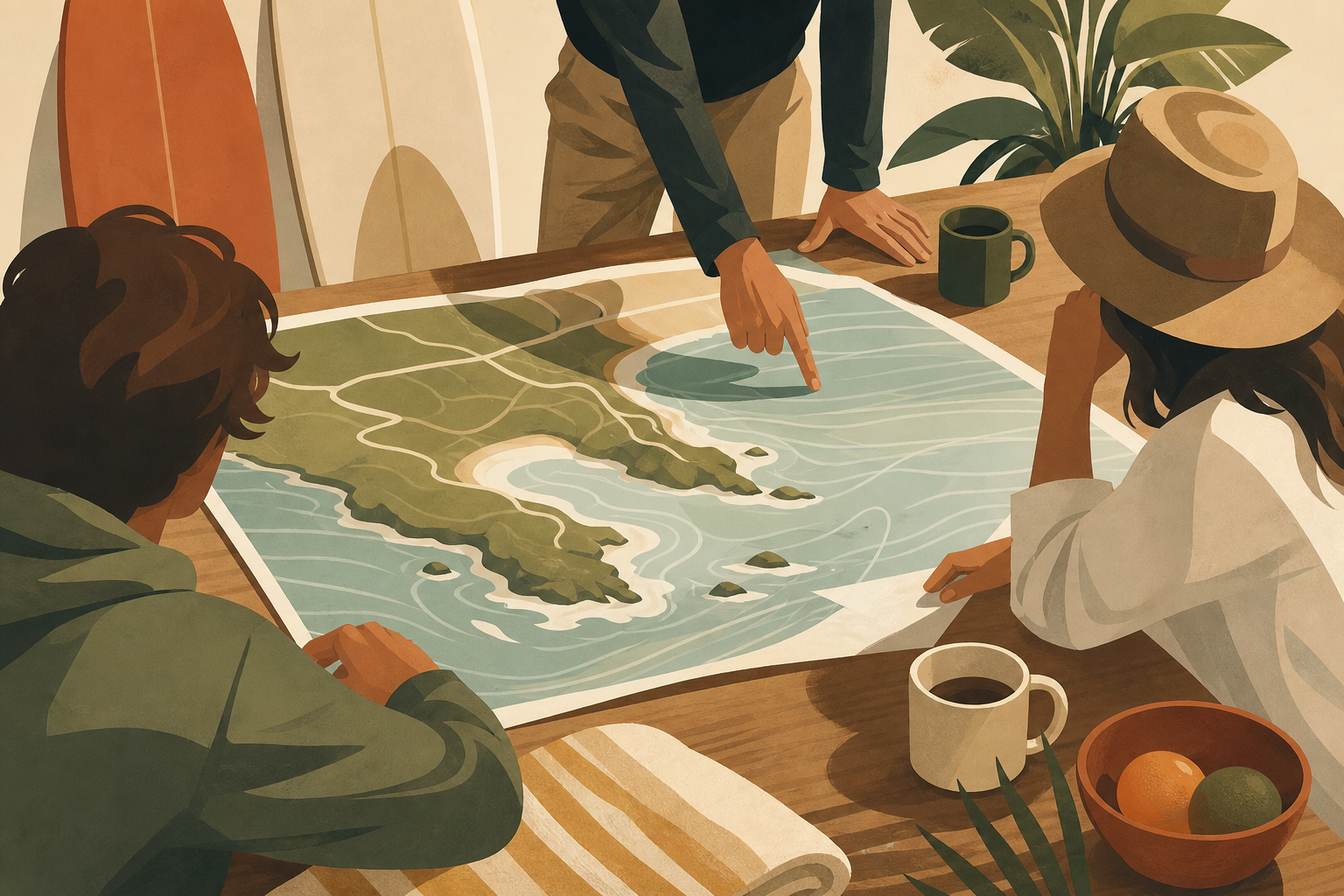
Okuragahama and Kanegahama are close enough to compare in one morning, but you do not need to surf both. Check, make a sensible choice, and save energy for the session or afternoon route. Repeated board loading and peak-hunting can consume the day.
For a first Hyuga visit, start with Okuragahama rather than treating Kanegahama as the required serious stop. A simpler beach-break setting often gives beginners a clearer way to observe and decide.
Treat driving times as rough estimates
Rain, roadworks, slow traffic, and missed turns can change a coastal drive quickly. Leave extra time for your first trip from JR Hyuga-Shi Station and avoid reaching an unfamiliar beach car park after dark. Finish packing calmly at dusk, check for keys and wetsuits, and drive back before fatigue becomes the main issue.
Keep safety separate from planning
A map shows location, not your fitness, ability, or the day’s hazards. Check conditions locally, follow beach notices, and use a qualified local instructor if learning. Experienced surfers should make conservative calls on swell, tide, currents, bottom contour, and crowds.
At Cross no Umi and Umagase Cliffs, respect wind, wet surfaces, and barriers. There is no need to climb closer for a photo.
FAQ
Q: Where is Hyuga on a surfing in Japan map? A: Hyuga is on the Pacific coast of northern Miyazaki Prefecture in Kyushu. It is a car-friendly base for Okuragahama Beach and Kanegahama Beach, not a walkable city-beach destination.
Q: Is Okuragahama Beach suitable for beginner surfers? A: It is known as a beginner-friendly beach break and is often the clearer first check for newer surfers. Conditions vary daily, so assess the water and arrange lessons or rentals locally if needed.
Q: How far are the beaches from JR Hyuga-Shi Station? A: Okuragahama is roughly 15–20 minutes by car, while Kanegahama is roughly 20–25 minutes. Allow extra time on your first drive and use beach-side parking where available.
Q: Do I need a car for a Hyuga surf trip? A: A car is strongly useful because the station, accommodation, beach parking, and sightseeing sites are spread out. Confirm board-transport rules with your rental company before arrival.
If your map looks busy, reduce it to one beach check, one backup plan, and one place everyone is happy to return to. Hyuga works best when you leave room for the morning decision instead of trying to complete every pin.
RESERVATION
Book Your Stay at Hyuga Surf Camp
A whole-house surf guesthouse in Hyuga, Miyazaki — close to Okuragahama and Kanegahama. Ideal for surf trips, groups, and beginners to experienced surfers. Check availability and rates on the booking site.
Book Your Stay at Hyuga Surf Camp
Please confirm current rates, availability and amenities on the booking site.
Comment